Boundless Edge
A performing arts school for ice skaters · Saugerties, New York · 2002-2012
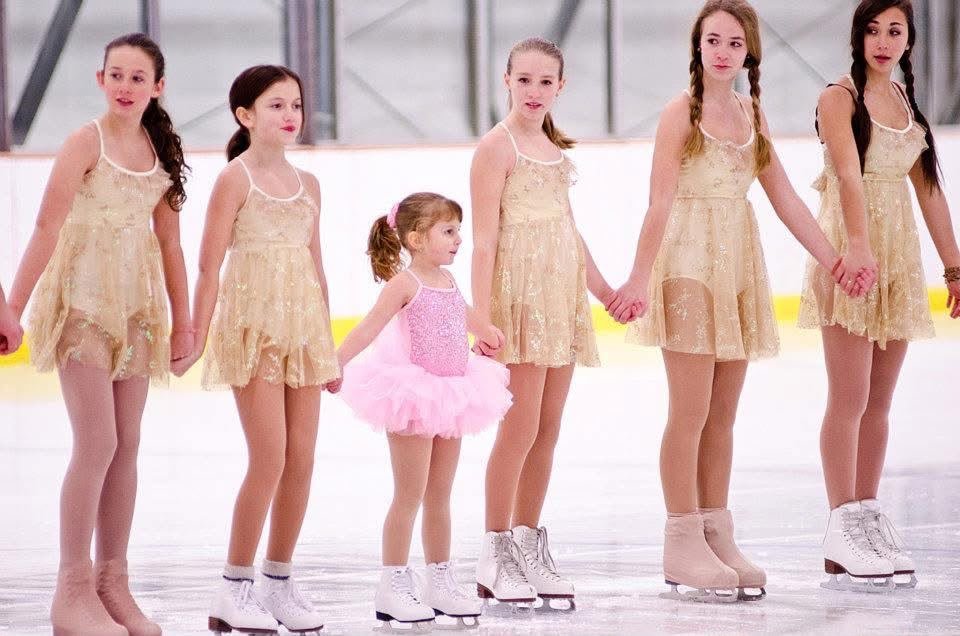
Every level on the ice at once, holding on to each other.
HOW IT BEGAN
I moved out of New York City to Hunter in the summer of 2002 and started looking for a rink. I was recovering from a foot injury and had not been skating for more than five years, but with David’s attention and encouragement I gradually felt brave enough to try again. He found the rink in Saugerties. We called many times that summer and no one ever answered. Finally, in August, someone picked up the phone.
We headed over to see this mysterious rink. There was hardly anyone on the full-size pristine ice. I was very excited to be skating again. I warmed up around the rink, then went to the centre to do a spin — a camel, a sit, a blur scratch spin. When I stopped with my signature toe tap, the way JoJo Starbuck always did, I found myself surrounded by the beaming smiles of a group of seven- and eight-year-old girls. They immediately began asking whether I could teach them.
Though I was the object of their attention, I was keenly aware that these children were so very special, so pure in their attention and their glee. All of them became my students for the next five years. They brought their friends, and overnight I had thirty students.
I didn’t know how I would teach all of them. David suggested I make some of the older students into assistants. One of the adults, Carl Carozza, was a science teacher; he was a beginner skater but a natural, and he was immediately able to teach what he had just learned. Over the next year or two I began a teacher training program and developed my own curriculum. It was very unusual, but my performing arts approach suited these very creative children.
When those original young girls became teenagers, most of them quit skating. I was quite disappointed; I had imagined they would one day be my company members.
You see, I had a vision in which skaters never entered the competitive world at all. I thought there was a whole population of skaters who would not fit in that world and who would rather be dancer-skaters, if they had the option. Why go up through the competitive ranks only to leave and skate with a company like Ice Theatre of New York? You don’t need triple jumps, or even doubles, to be a skating artist. You can have other valuable skills, the way dancers do.
WHAT IT WAS
Boundless Edge was a performing arts program for ice skaters. It gave skaters the chance to use the magical flow, glide and speed of ice skating while skating together with their friends in an ensemble. Ensemble skating is an alternative to competitions and to traditional show skating, with original choreography made for each group.
Every class began off the ice, with a dance warm-up taught by one of the local dancers — myself among them. That built the foundation of body control, strength and musicality. On the ice they learned all the traditional spins, jumps, turns and edges, and then something else: how to skate as a group unit, keeping in sync and in relation to one another while turning and gliding. That formation is called birding. John Curry established it as a company class format, and it is the basis of all group and ensemble skating. As students progressed, movement sequences were built up into a complete dance, and the highest level skaters performed in the Ensemble alongside their teachers and other professional skaters.
Instead of a testing structure there were the Rites of Passage — a non-competitive ladder that guides a student from a beginner toward being an ensemble skater capable of performing at a professional level. It allows for the differing talents of each individual and offers paths up that recognise a vast array of skills. An ensemble skater may or may not be capable of doing an axel; their particular skillset may focus strongly on musicality and flexibility rather than athleticism, which reflects the range of skillsets of working ensemble skaters.
Students never fail a test. They are simply not offered the next set of skills until they are ready to show mastery of them. That is continuous positive reinforcement, and it is what makes the learning work.
I ran the school for nine years.
The Ensemble performed alongside me and guest skaters from Ice Theatre of New York and other high-level artist skaters. Students were not each handed a solo, the way a traditional end-of-season recital hands them out. They were placed in group pieces that I choreographed and had roles in myself. Everyone had important tasks to attend to; everyone had to work hard in their role.
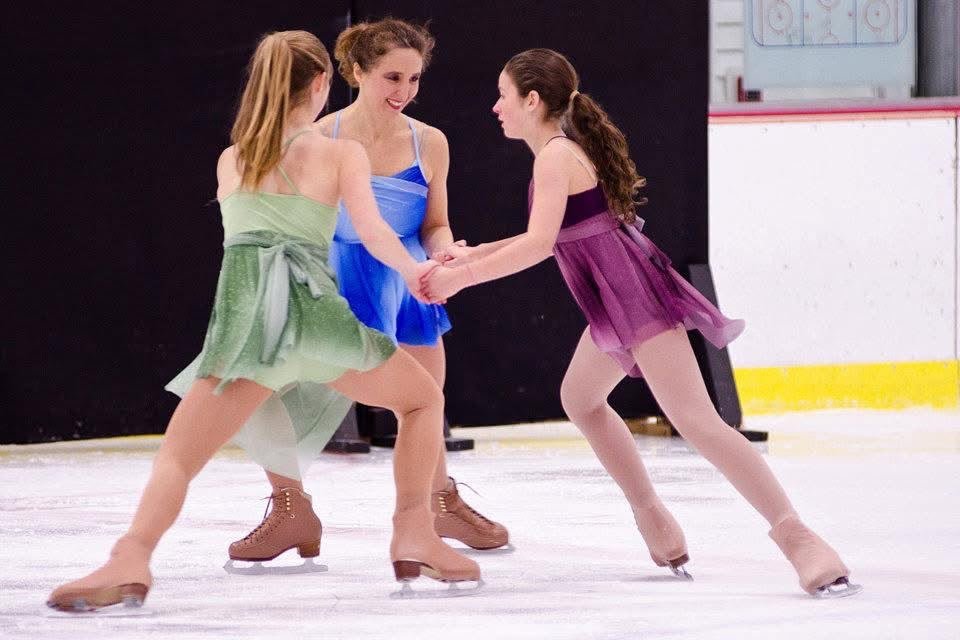
Skating together.
The performances ran thirty to fifty minutes with an intermission, and the community came — not just the relatives of the skaters. At our height we drew crowds of up to two hundred and fifty people, in the small town of Saugerties.
We skated twice a year at the Kiwanis arena in Saugerties and once a year with Ice Theatre of New York, and we were invited to the open-air ice pavilion at Mohonk Mountain House in New Paltz. One year the Olympic champion Oksana Baiul closed our show there with a solo, and I taught a workshop alongside her the next day. Seven of us skated that night — five young people and two professionals. One April, students from the school skated at Rockefeller Center. We skated at Riverbank State Park in Harlem too, through the New Works and Young Artists program I had started at Ice Theatre, and we collaborated with Arm of the Sea Theater at the winter festival in Milford, Pennsylvania.
I taught with Amy Thomas. The repertory was mostly short pieces: the large ensemble work Gloria in Excelsis Deo, The Path to Peace, and Till the End of Love, nine minutes long and built on Leonard Cohen, then Frank Sinatra, then Moby. That one was a reach for me — more idea-filled than dramatic, and a lot of risk taken choreographically.
We had no age group restrictions of the kind competitions impose, so we had the benefit of a mixed group of excellent skaters all dancing in one piece — fifteen of us in one holiday program, from six years old to late fifties. One of them was Celtic Techno, a fast, jump-filled piece inspired by Irish step-dancing, for three skaters: Diana, Sara Forsythe and Ana Alexander. Diana had skated as a child and come back to it as an adult, and later skated Winter-Summer in Persephone & the Birth of Winter. Sara and Ana both learned to skate in the school. Sara went on to become a very important part of Frozen Feet Theater, skating many of its major roles, and her family — Nancy and John Forsythe — were instrumental in both the school and the company. Carl Carrozza, who played Hades in Persephone, began as one of my students here: a science teacher of more than thirty years at Catskill Middle School who took up skating in his fifth decade, stayed eight years, and ended up teaching the beginners himself.
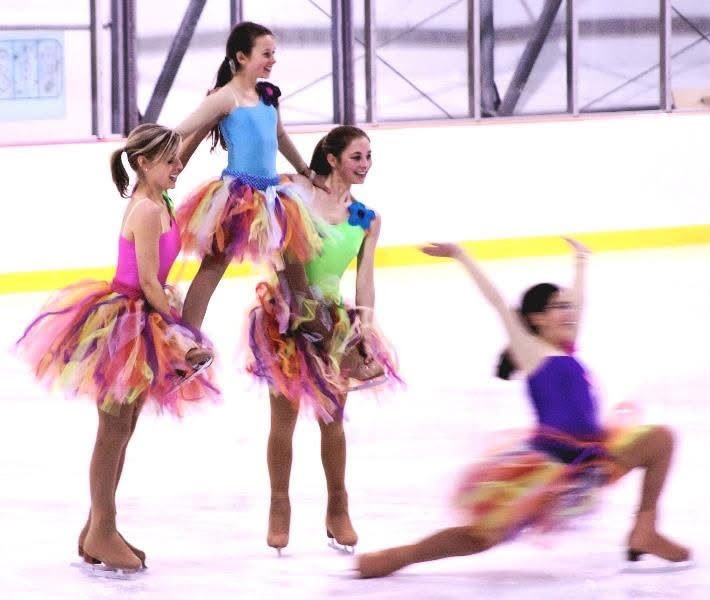
Sara entered the school in its fourth year or so, right before that first group of students quit. She was an amazing child: however many times she fell, she always smiled, got up and tried again. Nothing fazed her. She learned very quickly, and by the last years of the school she could shadow my movements perfectly. She had many wonderful roles, but watching her skate Berlin, 1928 with Patrick Connelly, an Ice Theatre of New York company member, astonished me and made me proud.
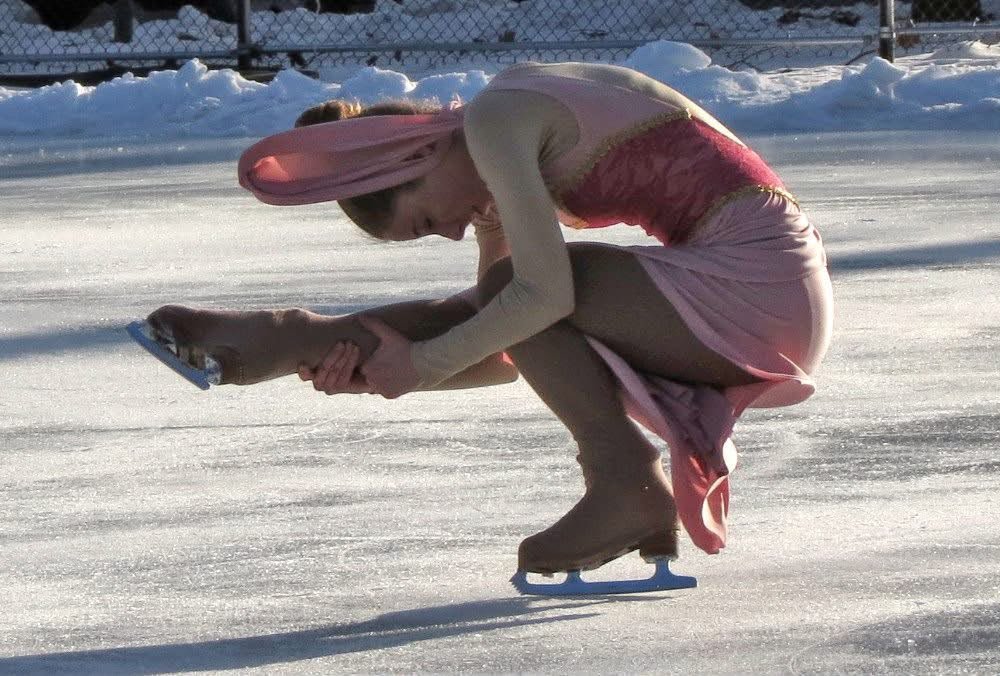
A sit spin, on the outdoor ice.
What I told a reporter then is still what I would say now. There are jumps, there are spins, but those things are used as punctuation points. They are not the meat of the performance. These are not Olympic skaters, they are not national-level skaters, but what we do, everybody does with conviction. You can get a feeling out of watching, and you can be touched by it. When you see somebody doing something they love and putting their heart into it, it is just so human and so real.
I wrote throughout those years. Three of those texts survive.
THE WRITINGS — A BLOCK AT THE FOOT OF THE PAGE, EACH WITH A LINK TO THE FULL TEXT
Ice Skating on the Boundless Edge: The Sport as a Performing Art. 2013. A book about skating outside the competitive system. Almost all skating training is built for competition and scores, and as soon as something is scored, rules are needed to frame the score — which predetermines the realm in which people create. The book proposes the alternative: no competitions, no scores, a curriculum of skills, and a way to make your own choreography and your own company. Twelve chapters planned, five written. The working title that April was Patinage Libre. Read it
The Boundless Edge Handbook. 2012, revised 2013. The school’s handbook. What ensemble skating is and how it differs from competition and show skating; the Rites of Passage set out level by level, from sit on the ice and stand up to ensemble choreography; and the practical chapters — how stiff a beginner’s boot should be, breaking skates in with wet socks and a warm oven, how often blades need sharpening and what the hollow should be, and what to wear in the coldest months. Read it
A Brief History of Ice Skating as an Artistic Expression. December 2007. A short history of skating as an art form: Canada Ice Dance Theatre in 1976, the first non-profit dedicated to skating as art; John Curry’s Theatre of Skating, which played the Metropolitan Opera and the Royal Albert Hall and lasted two years because a performance cost twenty thousand dollars to mount; Ice Theatre of New York rehearsing at one in the morning because that was the cheapest ice; and the sixty-work repertory ITNY built with modern dance choreographers. Read it
THE SUMMER CAMP
Every summer we ran a one-week camp, nine to three. Lunchtime was also a presentation hour: I showed videos on the history of artistic skating and on my own choreography with Ice Theatre of New York, and I taught the concepts in the drawings below — the shoulders, the hips and the waist moving in sequence, as Graham taught it, and moving completely, to the end of one’s range.
I did my best to give them an education, as if they would one day be professional skater-dancers.
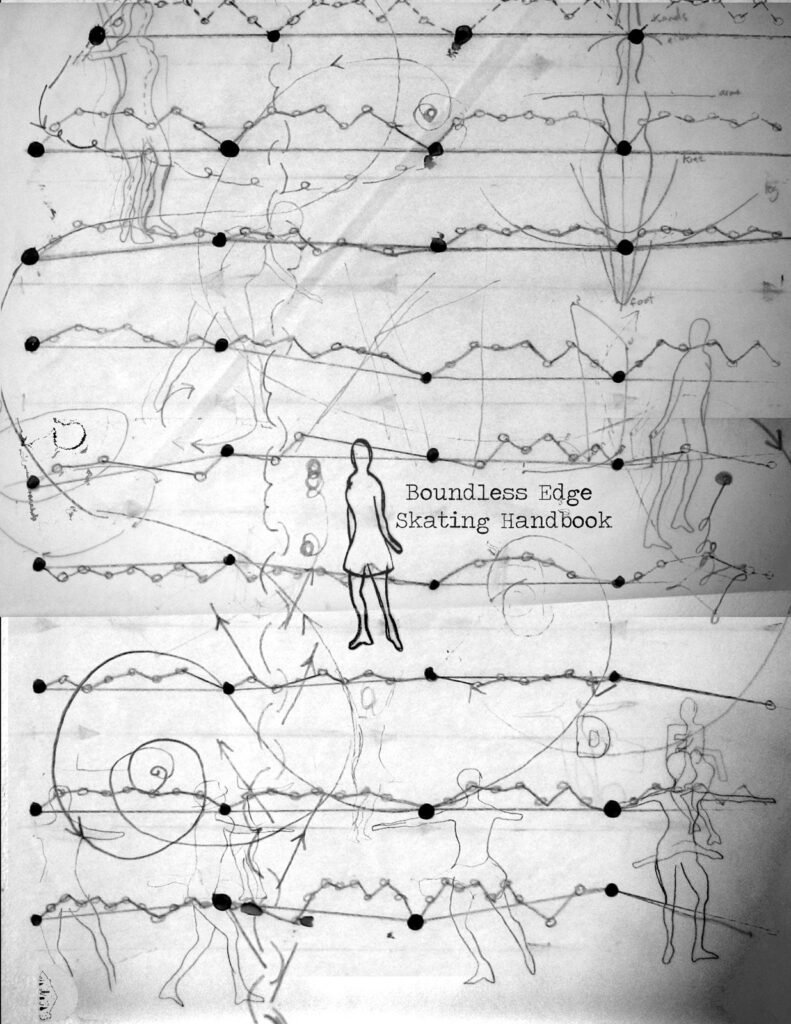
One of the covers.
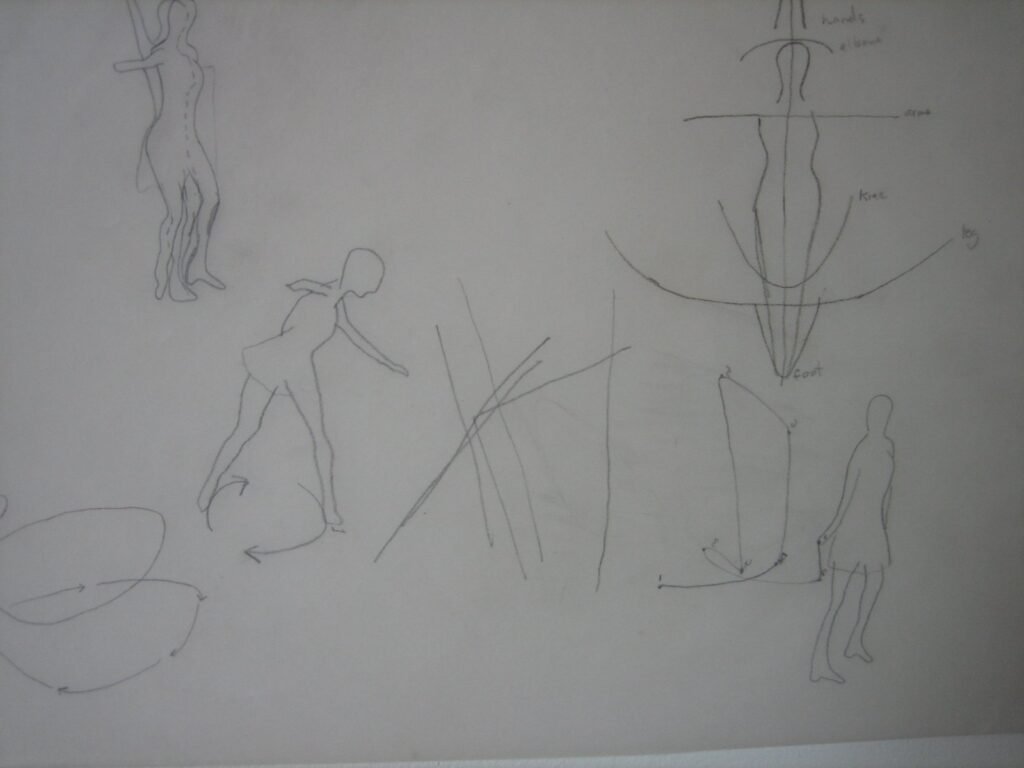
Hands, elbows, arms, knee, leg, foot — the parts named and the curves they move on.
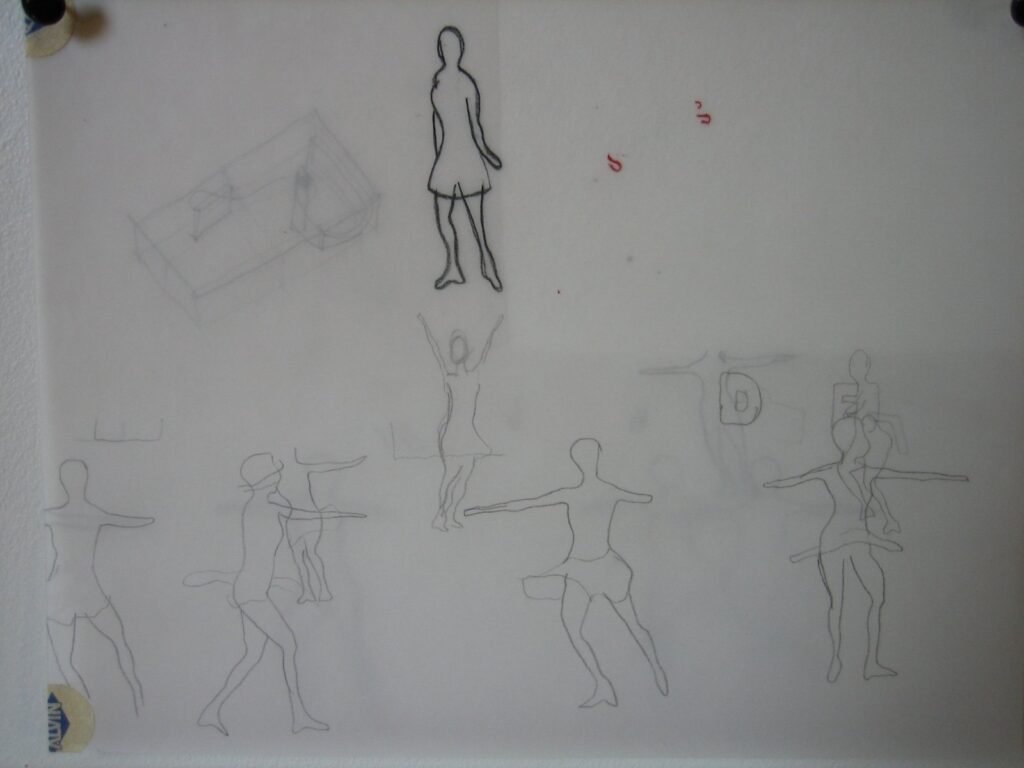
Positions worked out on paper.